
Introduction
The pharmaceutical industry is a highly regulated industry worldwide. Day-to-day operations include several approval processes to ensure compliance and operational efficiency. Despite this, many organizations are still relying on manual approval processes, from basic sign-offs to expense claims.
While manual approval process may appear manageable on the surface; they quietly drain time, increases compliance risks, and slow down critical operations.
The Hidden Cost of Manual Approval Processes in Pharma
Time Waster
∙ Manual workflows often involve chasing signatures, forwarding emails, or waiting for paper-based approvals.
∙ These delays occur across departments, slowing down product launches, MLR reviews, sales activities, and HCP engagement plans ultimately hampering commercial operations.
Risking Compliance
∙ When traceability of workflow is compromised, it is difficult to adhere to regulatory guidelines.
∙ Inconsistent approval records or missing documentation can cause costly audits and penalties.
Bottlenecks in Decision-Making
∙ When approvals sit in inboxes or on desks, decisions stall.
∙ Teams are forced to wait, rework plans, or escalate unnecessarily, creating friction between commercial, compliance, and operations teams.
Rising Operational and Financial Costs
∙ Manual approvals consume valuable employee time that could otherwise be spent on market execution and strategy
∙ Delayed approvals for contracts, campaigns, or rebates can result in missed timelines, lost opportunities, and increased operational overhead.
Why Pharma Companies Struggle to Scale with Outdated Systems
Linear Effort Growth
∙ Manual approvals do not scale, as every new request or transaction requires human intervention.
∙ The workload increases linearly as volume grows, so the only way to keep up is to add more people.
Coordination Load
∙ Communication layers and approval requirements increase with more brands, markets, and vendors.
∙ As a result, processes slow down and accountability suffers, with no clear picture of responsibility.
Fragmented Tools
∙ Spreadsheets, shared drives, etc. are fine for a small team but difficult to scale with larger groups.
∙ Data is scattered across silos, making reporting difficult and compliance harder.
Limited Visibility
∙ With no dashboards or comprehensive reports, leaders can't see bottlenecks or trends.
∙ Decisions are often made late or only after problems have escalated.
Change Fatigue
∙ The process adds chaos instead of clarity.
∙ Employees lose confidence in the system and disengage.
How Digital Workflow Automation Transforms Pharma Approvals
Digital workflow automation directly addresses the scaling challenges of the manual approval process.
Faster Cycles
∙ Requests, approvals, and tasks are automatically sent to the right team with predefined rules.
∙ There is no forwarding of email chains.
∙ Multiple stakeholders can review or approve the process, cutting down time drastically.
∙ Standardized workflows minimize errors or inconsistencies, reducing rework.
Real-Time Visibility and Control
∙ Dashboards and analytics provide visibility into real-time data, enabling leaders to make informed decisions.
∙ Every action is logged, enabling audit trails.
∙ With data flowing through a centralized system, companies can spot trends and intervene proactively.
∙ It creates transparency for all stakeholders.
Built-In Compliance and Governance
∙ Policy enforcement is enabled, with role-based permissions allowing authorized individuals to view or act on sensitive data.
∙ SOPs are codified into workflows, ensuring compliance across teams and markets.
∙ Automated logs and reports make audits smoother.
Digital workflow automation makes processes faster and shifts growth from headcount-driven to system-driven. It provides real-time control to leaders, embeds compliance and governance into workflows, and frees employees from repetitive tasks so they can focus on higher-value work.
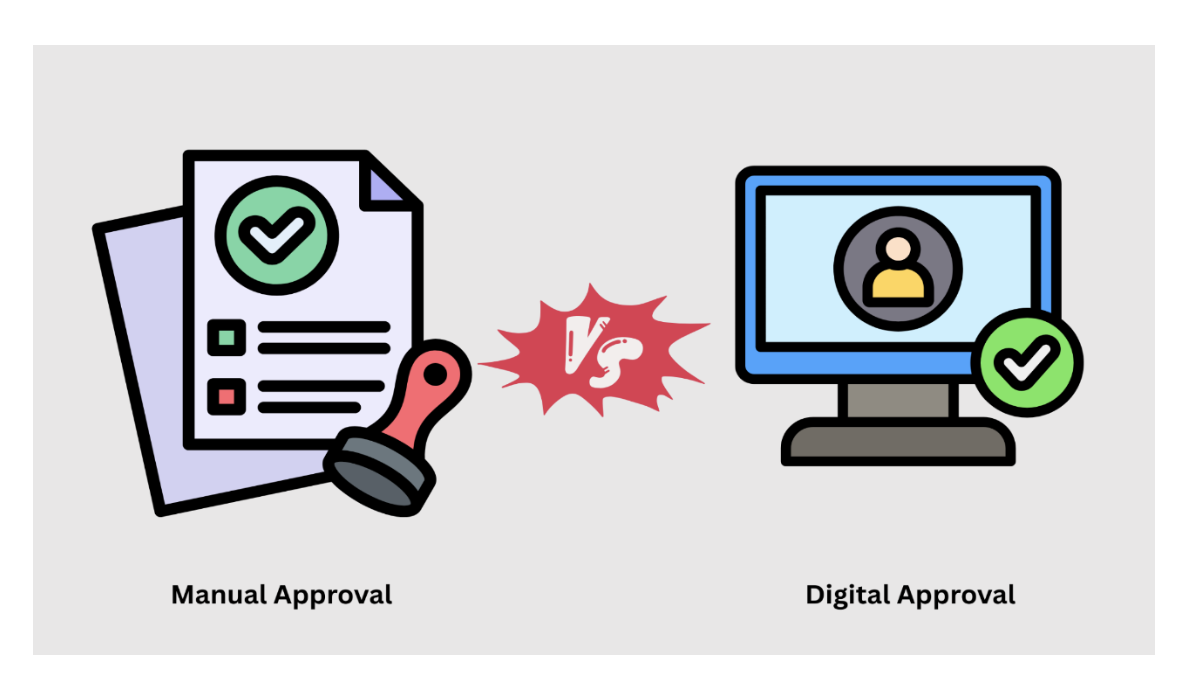
Manual vs Automated Approvals: A Clear Shift in Impact
Efficiency and Speed
∙ Manual approvals: Email-driven and dependent on human availability.
∙ Automated approvals: Allows parallel routing, conditional rules, and instant notifications.
Impact: Cycle times shrink from days/weeks to hours.
Scalability Without Headcount Growth
∙ Manual systems: Scaling volume requires proportional increases in coordinators and reviewers.
∙ Automated systems: Workflows scale digitally; one platform can handle thousands of requests simultaneously.
Impact: Organizations grow without increased administrative costs.
Transparency & Real-Time Visibility
∙ Manual systems: Leaders rely on fragmented spreadsheets and delayed reporting.
∙ Automated systems: Real-time Dashboards show throughput, bottlenecks, SLA compliance, and quality metrics in real time.
Impact: Leadership can intervene early, allocate resources intelligently, and track ROI continuously.
Compliance & Risk Management
∙ Manual systems: Policy enforcement depends on human memory, prone to error.
∙ Automated systems: Rules are embedded into workflows.
Impact: Compliance becomes proactive, not reactive, reducing regulatory risk and audit headaches.
Employee Productivity & Experience
∙ Manual systems: Staff spend hours chasing approvals, sending reminders, and reconciling spreadsheets.
∙ Automated systems: Employees focus on strategic work while routine approvals flow seamlessly.
Impact: Higher engagement, reduced burnout, and better retention.
Data-Driven Decision Making
∙ Manual systems: Fragmented data makes it hard to measure performance or identify trends.
∙ Automated systems: Centralized data enables analytics, benchmarking, and predictive insights.
Impact: Commercial operations evolve from reactive to proactive optimization.
Conclusion
Manual approval processes may seem familiar, but they silently undermine speed, compliance, and scalability in pharma operations. Automation shifts growth from headcount-driven to system-driven, enabling scalability without proportional cost increases.
With automation in approvals, pharma companies can unlock benefits including faster commercial launches, lower operational costs, stronger compliance posture, smarter resource allocation, and more productive teams.
In a highly regulated market, this flexibility allows companies to adapt quickly and stay ahead of competitors.