
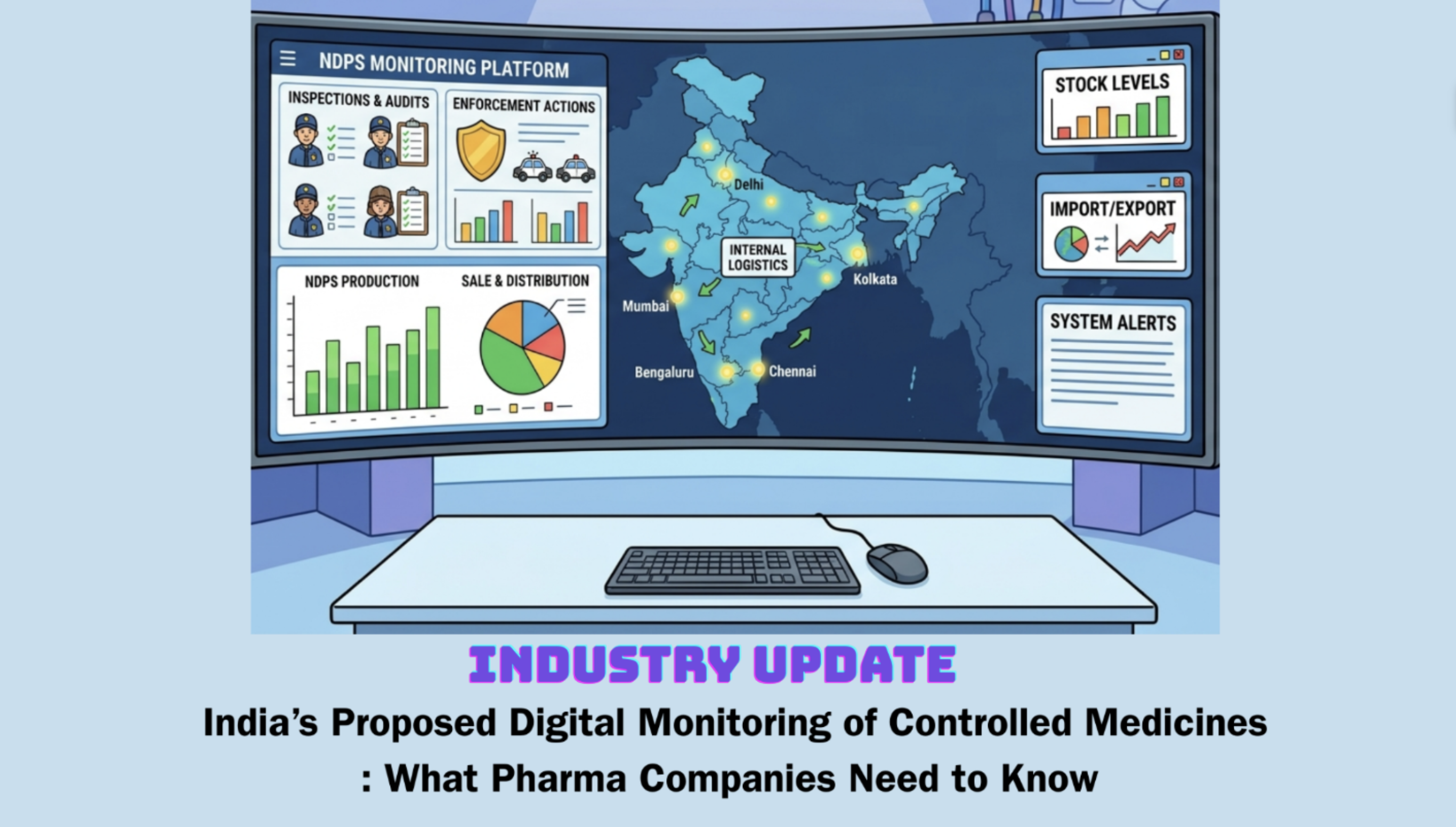
India’s Proposed Digital Monitoring of Controlled Medicines: What Pharma Companies Need to Know
A recent regulatory development aims to address regulatory gaps contributing to the illegal diversion
and misuse of controlled medicines by March 2027.
Under India’s Vision Document on Drug Control 2026-2029, the Drugs Consultative Committee
(DCC), during its 70th meeting, recommended the creation of a common digital platform to monitor
and analyze data related to the manufacture, sale, stocking, inspections, audits, and enforcement
activities for narcotic drugs and psychotropic substances (NDPS).
Sources: Official 70th DCC meeting minutes
The proposed framework is intended to support a centralized database covering:
- -Manufacturing of controlled medicines
- -Sales and distribution
- -Stocking and inventory
- -Regulatory inspections
- -Compliance audits
- -Enforcement actions and violations
To support these objectives, the DCC recommended that the Central Drugs Standard Control Organization (CDSCO) develop a uniform reporting framework and a common digital platform that can aggregate, analyze, and monitor data submitted by States and Union Territories.
Why This Matters
India’s controlled substances market includes medicines used in pain management, psychiatry,
neurology, and addiction treatment. However, inadequate oversight can increase the risk of
diversion, unauthorized distribution, misuse, and the entry of controlled medicines into illicit markets.
The proposed digital framework could improve visibility across the entire supply chain, which will
strengthen regulatory enforcement.
Impact on Pharma Companies
Companies most likely to be affected include opioid manufacturers, CNS companies, controlled- substance API manufacturers, and contract manufacturing organizations handling NDPS products. Enhanced regulatory reporting will be required, with pharma companies needing to provide data on the production, inventory, movement, and sales of controlled medicines. Companies handling controlled substances should review their existing controls for batch reconciliation, inventory management, product returns, distributor oversight, destruction and disposal records, and audit readiness.
Why Greater Digital Monitoring Is Needed
Monitoring controlled medicines across manufacturing, distribution, and storage requires reliable and
consistent data. Delayed reporting, inconsistent records, or disconnected systems can make it
harder to identify discrepancies between production, inventory, and market distribution. A centralized
digital platform could help regulators compare data across these stages and identify potential
irregularities more efficiently.
How a Centralized Digital Platform Can Strengthen Visibility, Oversight and Compliance
Improving visibility
● Better visibility into the movement of controlled medicines across the country.
● Better identification of unusual sales, inventory, or stocking patterns through data analysis.
Strengthening Regulatory Oversight
● A centralized database can help identify inconsistencies in the supply chain.
● Data-driven monitoring could help regulators prioritize inspections based on identified risks
and direct resources toward facilities that require closer scrutiny.
● Access to data will shorten investigation timelines and improve coordination between
enforcement agencies.
Improving Compliance
● Digital reporting encourages standardized documentation and reduces reliance on manual
processes.
● Connected data across the supply chain could help identify discrepancies and potential
diversion risks earlier.
What Data Will Matter Most
● Manufacturing data would provide the foundation for the entire monitoring system. It will
help regulators establish the legitimate supply entering the market.
● Inventory and stocking data can highlight stock accumulation or inventory discrepancies.
● Sales and distribution data against manufacturing and inventory records can show product
movement and identify unusual trends.
● Regulatory and compliance data showing inspection findings, audit observations, and
enforcement records could help recognize recurring compliance issues and prioritize follow-
up actions.
Why Data Quality Will Be Critical
Accuracy: Inaccurate reporting could create false alerts or obscure compliance issues. The
accuracy of submitted data is paramount for manufacturers and other stakeholders.
Timeliness: Timely data submission could help regulators identify discrepancies sooner and
respond to potential supply-chain risks more effectively.
Integration: Integrating manufacturing, inventory, sales, inspection, and enforcement data could
help reveal patterns that may not be apparent when records are reviewed separately.
Impact on Pharma Manufacturers
Companies may need to submit more frequent and structured data related to production volumes,
batch-level information, distribution records, product destruction, and returns.
Manufacturers need to ensure that ERP systems generate accurate records and that documentation
is inspection-ready at all times.
Impact on Distributors and Supply Chain Partners
Stronger traceability is expected for controlled medicines across the supply chain, and product
accountability would be a key compliance factor.
These organizations may need to strengthen inventory controls, stock reconciliation, and inventory
verification.
Impact on Regulatory Affairs Teams
Regulatory affairs teams should coordinate with manufacturing, supply chain, IT, and quality teams
to support data accuracy, maintain consistent records, and prepare for any future reporting
requirements.
Preparing for a More Digitally Connected Regulatory Environment
Pharma companies need to focus on four critical pillars: data accuracy, data integration, traceability,
and governance.
Data Accuracy and Data Integrity
Companies need to establish robust data validation processes, implement automated exception and
discrepancy reporting, and conduct periodic internal audits.
Data Integration Across Functions
● A well-integrated data environment helps create a single source of truth, reduces reporting
errors, enables faster responses to regulatory requests, and supports end-to-end visibility of
controlled medicines throughout the supply chain.
End-to-End Traceability
● A strong traceability system can help companies detect diversion risks earlier, improve
recalls, and support regulatory investigations.
Data Governance Frameworks
● Organizations need to define data ownership, accountability, workflows, and data-retention
policies.
Conclusion
The proposed digital platform has the potential to transform how controlled medicines are monitored
and regulated in India. For pharma companies, investing in data accuracy, integration, and
traceability today will be key to compliance tomorrow.