
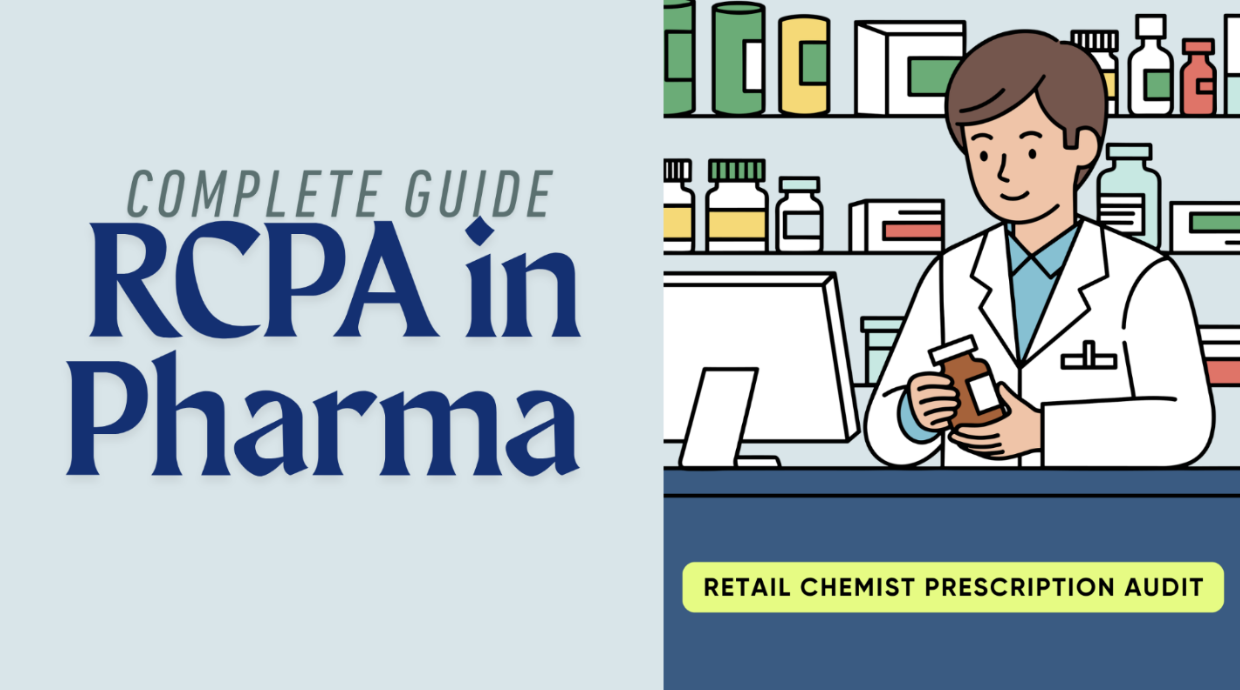
RCPA in Pharma: Complete Guide to Process, Data & Benefits
RCPA (Retail Chemist Prescription Audit) is one of the most valuable sources of ground-level
market intelligence for pharmaceutical companies. It helps field teams understand prescription
trends, brand movement, competitor activity, and product availability directly from the retail market.
Hence, it is often identified as the "eyes and ears" of the field force.
RCPA in Pharma is a systematic process where medical reps collect prescription, brand movement,
competitor, and retail-level market insights through interactions with retail chemists.
The data can include:
● Doctor/brand prescription trends observed through retail interactions
● Brand-wise sales movement
● Competitor activities
● New product uptake
● Stock availability, etc.
Why RCPA?
Micro-level Data
Research reports provide a helicopter view of new trends, whereas RCPA provides territory-level
insights into market share and doctor-level prescription patterns. It captures micro-level evidence
through direct interactions with druggists. Medical representative reporting in RCPA helps capture
field-level prescription and competitor insights.
Competitive Intelligence
RCPA can highlight the strengths and weaknesses of your competitors. It answers questions such as
which doctors are shifting prescriptions, who the new players are, and so on.
It plays a vital role in competitive strategy when insights highlight new launches, discounts and
schemes, HCP engagement activities, sample distribution, etc.
Validation
It is a tool that validates the ground efforts of medical reps. Does field activity align with prescription
and brand movement trends? With this visibility, managers can optimize call planning, coverage
strategy, and resource allocation more effectively.
Sales Forecasting and Stock Management
RCPA reports can indicate major trends in prescription and brand movement and can complement
secondary sales data for forecasting and demand planning.
Poor product performance can sometimes be linked to stock unavailability, distribution gaps, or
supply chain issues. RCPA can help identify such issues, enabling corrective measures to be
implemented.
How the RCPA Process Works
Medical reps identify priority Healthcare Professionals (HCPs) whose prescription behavior needs to
be tracked. Once the Healthcare Professional is identified, the next step is to map relevant retail
chemists where prescriptions associated with the HCP are commonly filled.
Visit chemists regularly to understand product movement, collect brand-wise observations, assess
competitor performance, and check inventory. Capture intelligence such as rival activities, schemes,
new launches, and HCP preferences.
Maintain a warm relationship with pharmacists to gain access to these details. Record these findings
in your Pharma CRM to support medical representative reporting and analytics.
The process does not end with recording. Tracing progress over time and developing action plans
are the subsequent steps.
What Data Is Collected During an RCPA Visit?
Collecting key intelligence is pivotal in shaping the revenue plan. The information should answer
questions such as: Who prescribes? What is prescribed? And why is it prescribed?
● Doctor-level facts such as the number of prescriptions, drugs prescribed by the physician,
prescribing patterns, etc.
● Brand-level details such as own-brand movement, competitor brand movement, estimated
share within the tracked market, new entrants, etc.
● Competitor findings including promotional activities, sample distribution, CME activities, trade
schemes, etc.
● Retail figures about top-selling brands in a particular therapy, drug substitution patterns,
customer demand patterns, generic vs. branded preferences, stocks, untapped
opportunities, and new clinics or hospitals within the region.
Benefits of RCPA for Pharma Companies
This is one of the most immediate sources of information available to pharma field teams.
It helps teams monitor market share at the HCP and territory levels and identify potential prescription
conversion opportunities.
Monitoring competitor performance provides early warning signs of change. It helps managers
improve territory planning, allocate resources effectively, and strengthen field coaching.
Having visibility into inventory helps address supply chain issues. Sales forecasts become more
predictable based on brand dynamics. Data-driven decisions can create a long-term positive impact
on business growth.
Challenges of Manual RCPA Tracking
Manual recording of RCPA insights is a time-consuming process, as it can take significant time to
collect and document facts. Accuracy issues may emerge because recorded facts may be
incomplete or incorrectly captured.
The input may reach managers days or weeks later, causing delays in decision-making and
corrective action.
Inconsistencies in details arise when people follow different approaches, resulting in non-
standardized input and an increased risk of human error.
Capturing real-time rival product movements is difficult in a manual process, and validation often
remains questionable.
How Digital RCPA Reporting Improves Field Productivity
It reduces administrative work for the field force, as figures can be captured directly on mobile
devices.
Details are available in real time, making it easier for management to make decisions.
Digital forms are standardized, removing errors and inconsistencies while saving time.
Real-time analytics can help teams identify distribution trends, competitive shifts, and brand
movement patterns. This improves sales force effectiveness.
Integration with CRM systems enables daily call reporting, Pharma KPI analysis, and RCPA features
in a single platform.
Keacyte's RCPA module supports real-time RCPA data capture, pharma competitor analysis, data
validation, and analytics to help pharma companies make faster, data-driven commercial decisions.
With validation rules and approval workflows, Keacyte helps improve the consistency, quality, and
usability of RCPA data while supporting compliant field processes.
Best Practices for Effective RCPA
Addressing key questions related to your portfolio and competition must remain a primary focus.
This can be achieved by:
● Focusing on priority doctors
● Selecting relevant retail chemists
● Visiting regularly
● Verifying information from multiple sources
● Capturing competitor input
● Recording data digitally
● Analyzing trends
● Tracking stock details
● Sharing insights with management for discussion and action
Conclusion
RCPA is a critical market intelligence tool for the pharmaceutical industry that helps measure
prescription conversions, improves competitive understanding, and supports better business
decisions.
An effective RCPA process, especially when digitized, enables pharma companies to convert field
insights into actionable strategies that improve prescription generation, market share, and overall
business performance.