
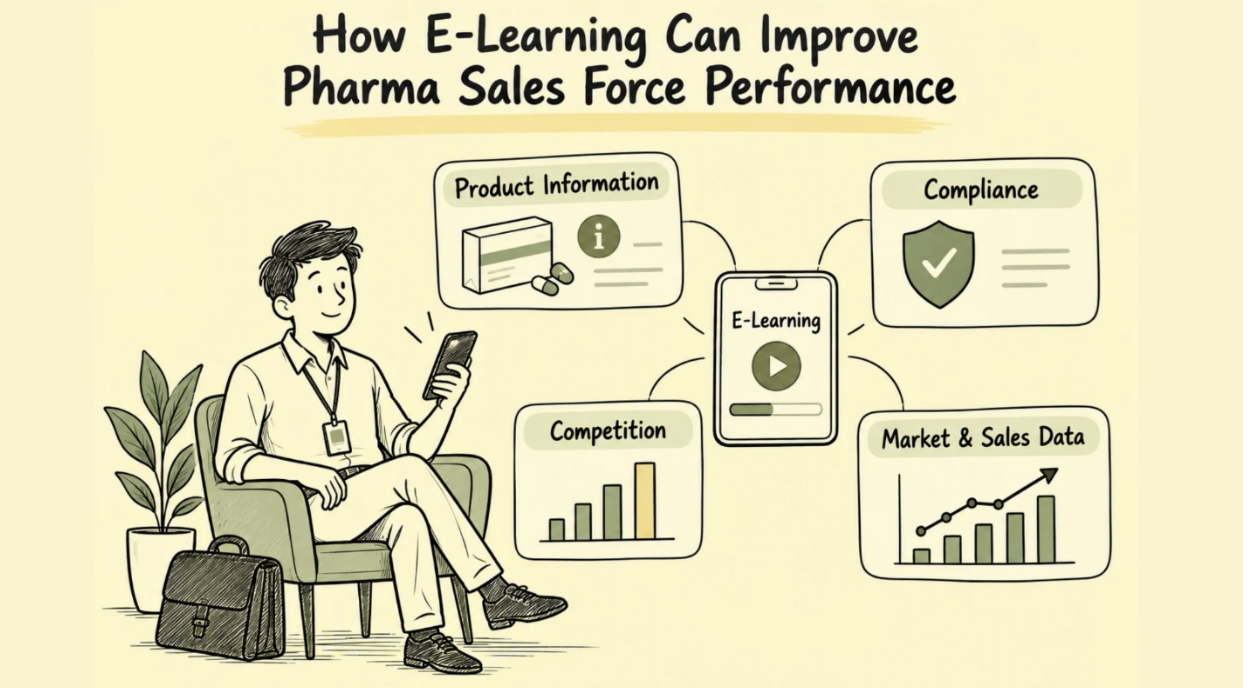
Pharmaceutical sales reps are expected to have in-depth knowledge of products, therapeutic areas,
diseases, competition, regulatory compliance, and customer engagement techniques.
When a physician interacts, MRs should be confident enough to communicate scientific information,
address queries, and discuss product benefits accurately.
E-learning is an excellent way to continuously develop these capabilities. With digital learning
programs, field forces can stay updated and feel more confident in their doctor interactions and in
handling queries.
E-learning offers continuous education, unlike traditional classroom coaching that occurs a few times
throughout the year. As the industry is evolving, so are new product launches, emerging therapies,
compliance requirements, and evolving physician expectations, putting pressure on the sales force
to stay updated and relevant in the competition.
Effective pharma sales training plays a critical role in improving knowledge and field readiness.
Practical Ways E-Learning Improves Sales-Force Performance
Continuous Training
Companies do not have to worry about the physical delivery of lectures or coaching, as e-learning
makes new studies, protocols, and updates available quickly and regularly across the field force.
Flexible Learning
Sales forces spend a lot of time in the field, and e-learning is an excellent opportunity to access
information anytime and anywhere on mobile devices.
Knowledge Retention
Traditional coaching may lead to knowledge-retention problems in the long run; however, short and
interactive digital learning sessions are easy to consume and remember.
Standardized Training
The beauty of digital modules is that all reps receive the same training regardless of location, region,
or manager.
Faster Onboarding
No more waiting for classroom training for new joiners; digital learning can help them onboard as
quickly as possible.
Knowledge Gaps
It is hard to understand knowledge gaps in conventional training; however, assessments and quizzes
help organizations identify the grey areas that require training.
Learning Analytics
Training data helps managers track course completion rates, scores, skill development, and
supports one-to-one sales force coaching.
Learning analytics also contributes to pharma sales force effectiveness by identifying capability gaps
and training opportunities.
Practical Implementation Framework for Pharma Learning
It is crucial to have a practical implementation framework for the learning module to achieve
maximum adoption and effectiveness.
Step 1: Identify Training and Skill Gaps
It is the most important step to understand the existing gaps within sales teams. It is recommended
to review field effectiveness reports, field observations, coaching discussions, product assessments,
manager feedback, etc.
It also helps determine whether the sales force has adequate product knowledge and sufficient
scientific, compliance, and selling skills.
The gaps will reveal the way forward to address actual business needs.
Step 2: Define Learning Objectives
After gap analysis, training needs are identified. Drug companies should define clear learning
objectives.
Whether the need is for product training or compliance training, capability-development goals should
be measurable and aligned with the company's strategy.
Step 3: Develop Relevant and Role-Specific Content
A one-size-fits-all training approach may not address the different learning requirements of every
role. The training content should be tailored to different roles and responsibilities.
It should be specifically designed for MRs, First-Line Managers, New Employees, etc., as it improves
relevance and engagement.
Step 4: Select the Right Learning Platform and Delivery Format
Selecting the right learning and delivery platform is critical for success. Choose a platform with
mobile accessibility, a user-friendly interface, CRM integration, offline access, analytics, and support
for videos, assessments, podcasts, and microlearning modules.
Keacyte's E-Learning and Coaching Modules
Keacyte's E-learning and Coaching modules combine interactive training with real-time coaching to
drive continuous growth.
Managers can provide timely feedback, assess field force performance, and set clear improvement
goals using customizable evaluation forms.
Designed for pharma teams, Keacyte helps boost skills, productivity, and professional development,
all in one integrated platform. The platform also supports sales force performance management
through continuous learning and coaching workflows.
Step 5: Launch and Encourage Adoption
If the sales team is not adopting e-learning, then it is a red flag. Companies should make sure
employees receive the best learning experiences and are provided with onboarding support.
Organizations should create a culture where learning is viewed as part of daily work rather than an
additional task.
Step 6: Assess Knowledge and Learning Outcomes
Knowledge development and assessment should go hand in hand. Through engaging assessment
methods, pharma companies should measure learning completion, knowledge improvement, and
skill development.
Step 7: Continuously Improve the Program
The beauty of digital modules is that they can continuously evolve based on feedback and field
effectiveness data.
Capability-building programs can be improved using feedback, assessment results, managers'
observations, sales trends, and market changes.
Regular updates on products, compliance requirements, and selling skills should be ensured for
long-term effectiveness.
E-Learning and Sales Force Coaching: Working Together
Rather than stressing either mode of learning, whether digital or human coaching, a blended
approach would be constructive.
As e-learning provides product updates, compliance awareness, and quick delivery of knowledge,
sales force coaching provides practical application, real-world feedback, and field guidance.
Along with field observations, it provides actual execution insights, call quality assessments, and
customer interaction feedback.
Learning should not happen in isolation; rather, it should bring coaching and feedback together to
achieve better results.
Conclusion
E-learning opens the window to a continuous learning and capability-improvement approach for the
pharmaceutical field force.
Companies that adopt digital learning modules will have a scientifically equipped sales force. It also
accelerates onboarding, standardizes learning across teams, identifies knowledge gaps, and
provides valuable insights through analytics.
When combined with sales force coaching, field observation, and execution feedback, e-learning
becomes a powerful tool that supports individual growth and a company's long-term success.