
Introduction
Healthcare professionals (HCPs) are at the center of every successful pharmaceutical
commercialization strategy.
Engaging with healthcare professionals is a key activity for pharmaceutical sales teams and
helps build meaningful relationships in a competitive market.
According to IQVIA Channel Dynamics™ 2025, healthcare professionals are becoming
increasingly harder to reach and more selective about how they engage with pharmaceutical
companies, highlighting the importance of personalized and preference-based HCP interaction.
HCP communication should balance scientific evidence, clinical insights, and product
information to create meaningful interactions that deliver value beyond promotion. As physicians
become more selective about the information they consume, generic promotional messages are
less likely to capture their attention.
This shift has compelled drug companies to focus on building meaningful long-term
relationships with doctors.
Traditional sales visits build relationships, and the use of technology enables pharmaceutical
companies to maintain relevant and consistent communication with physicians across multiple
channels.
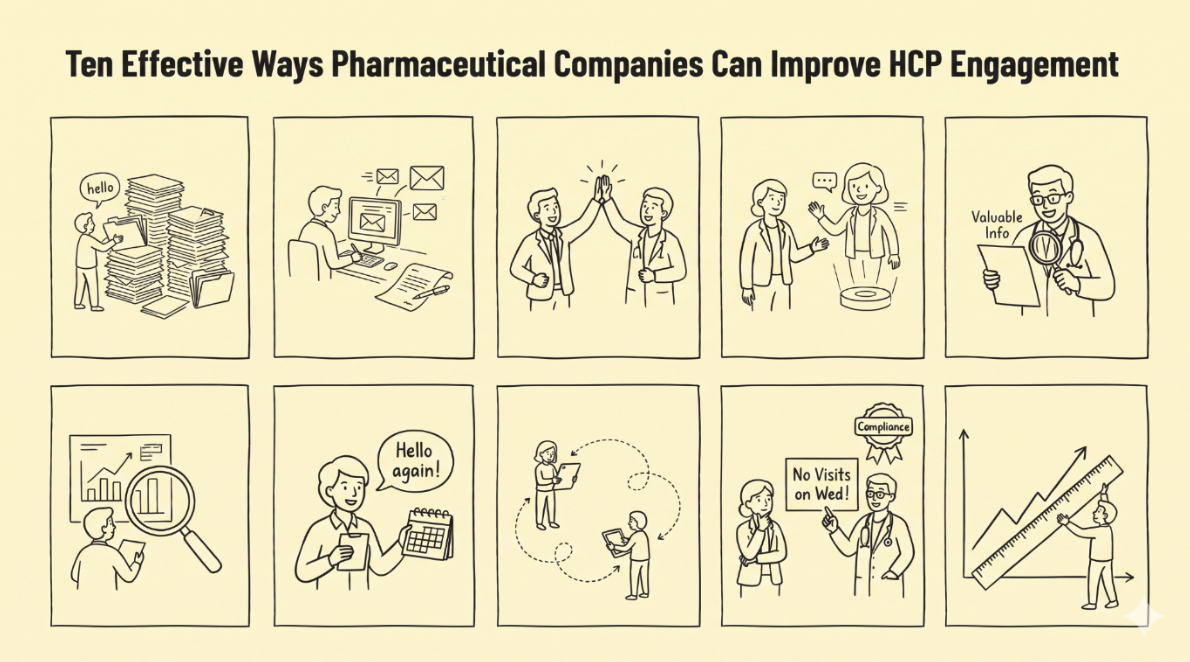
This article explores ten effective ways pharmaceutical companies can improve HCP
engagement and develop stronger, more impactful relationships with physicians.
1. Maintain Accurate and Updated HCP Data
Accurate HCP data forms the foundation of every successful engagement strategy.
With incomplete records on doctors, it is like shooting in the dark with no clear target. This will
also create confusion when sharing relevant data with HCPs.
Having complete information about doctors, their expertise, and practice areas is very important
for meaningful conversations. It can improve physician targeting and segmentation. It can
enhance call planning and territory management.
Complete and updated HCP records help sales teams define clear engagement objectives and
tailor their communication to individual physicians.
2. Personalize HCP Interactions
Historical conversation holds significant value in building relationships. Once the HCPs'
specialties and preferences are known, along with previous interaction history, the
conversations become clearer and more personalized.
What matters in holding physicians' attention is those details and nuances from your historical
discussions, and delivering the right message, as time is a big constraint when MRs visit
doctors.
Personalization will enhance engagement rates, improve communication, and build stronger
relationships.
3. Strengthen Field-Force Engagement
Pharma companies need to equip and train their field force to conduct more effective and meaningful interactions with doctors.
Adopting technology and pharma CRM platforms like Keacyte can help sales teams with call planning, daily call reporting, event management, content management, and HCP consent management, making one-to-one interactions more effective.
Confident sales reps equipped with the right technology will enhance engagement. It will lead to meaningful discussions, improve call quality and effectiveness, and increase sales force productivity.
4. Use Digital Channels Alongside Field Visits
Personal visits are excellent ways of engagement; however, the post-COVID era has changed
the work culture of several healthcare institutions and imposed restrictions on field visits.
E-detailing enables medical representatives to present product information, clinical evidence,
visual aids, and educational content through digital platforms. Closed-Loop Marketing (CLM)
further supports engagement by tracking how HCPs interact with digital content.
When used effectively, digital channels complement personal visits and help pharmaceutical
companies maintain consistent communication with HCPs.
5. Create Relevant and Valuable Content
Sales teams delivering scientific and key product information help physicians recall the brand.
Generic or overly promotional content is less likely to stand out in a competitive environment.
The insight should be able to provide product details and scientifically supported clinical
information because HCPs' prescription decisions are immensely affected by valuable and
relevant content.
6. Use Data to Understand HCP Engagement
Data is the new gold mine for effective engagement. By tracking physician interactions,
responses, content consumption, and engagement patterns, pharmaceutical companies can
gain actionable insights into HCP behavior, prescribing habits, and communication preferences.
The data can help build personalized content, circulate it across different omnichannel
platforms, and guide MRs before their next visits.
These insights can also support targeted sales-force coaching, improve field execution, and help
teams refine future engagement strategies.
7. Follow Up Consistently
Engagement should not end after a field visit or e-detailing session. Timely, relevant follow-ups
help maintain continuity in HCP communication.
Consistent and relevant communication can reinforce brand recall more effectively than relying
on a single interaction.
Follow up consistently with relevant content to nurture stronger relationships with HCPs while
respecting HCP communication preferences.
8. Coordinate Field and Digital Engagement
Field visits and digital engagement should work together rather than operate as separate
activities. HCPs should receive consistent and coordinated communication across medical
representative visits, e-detailing sessions, events, and other relevant channels.
Modern HCP engagement is most effective when all communication channels work together to
deliver a connected and consistent experience.
9. Respect HCP Preferences and Compliance Requirements
Pharmaceutical companies should ensure that HCP personal data is collected, processed,
stored, and used responsibly in accordance with applicable data protection requirements,
including the relevant provisions of India's Digital Personal Data Protection (DPDP) Act as they
come into force.
Ensuring transparency in all communications, data handling practices, and compliance
processes fosters trust and strengthens regulatory compliance.
10. Measure and Continuously Improve Engagement
Tracking metrics such as interaction frequency, HCP reach, response rates, consent status, and
channel performance helps pharma companies measure and optimize engagement
effectiveness. These insights can guide sales planning, identify improvement areas, and refine
future engagement strategies.
Conclusion
HCP engagement is a critical part of the pharma sales cycle; however, the number of
interactions does not translate into success. It is effective communication, the use of data,
analytics, and CRM systems that equip the sales force to have personalized, coordinated, and
measurable engagement.
Meaningful brand recall is more likely when communication highlights relevant, scientifically
supported product information and clinical value rather than unnecessary promotional content.
Use these insights to make every interaction with HCPs more relevant, valuable, and
memorable.